|
|
|
|
Dear Principals and School Leaders,
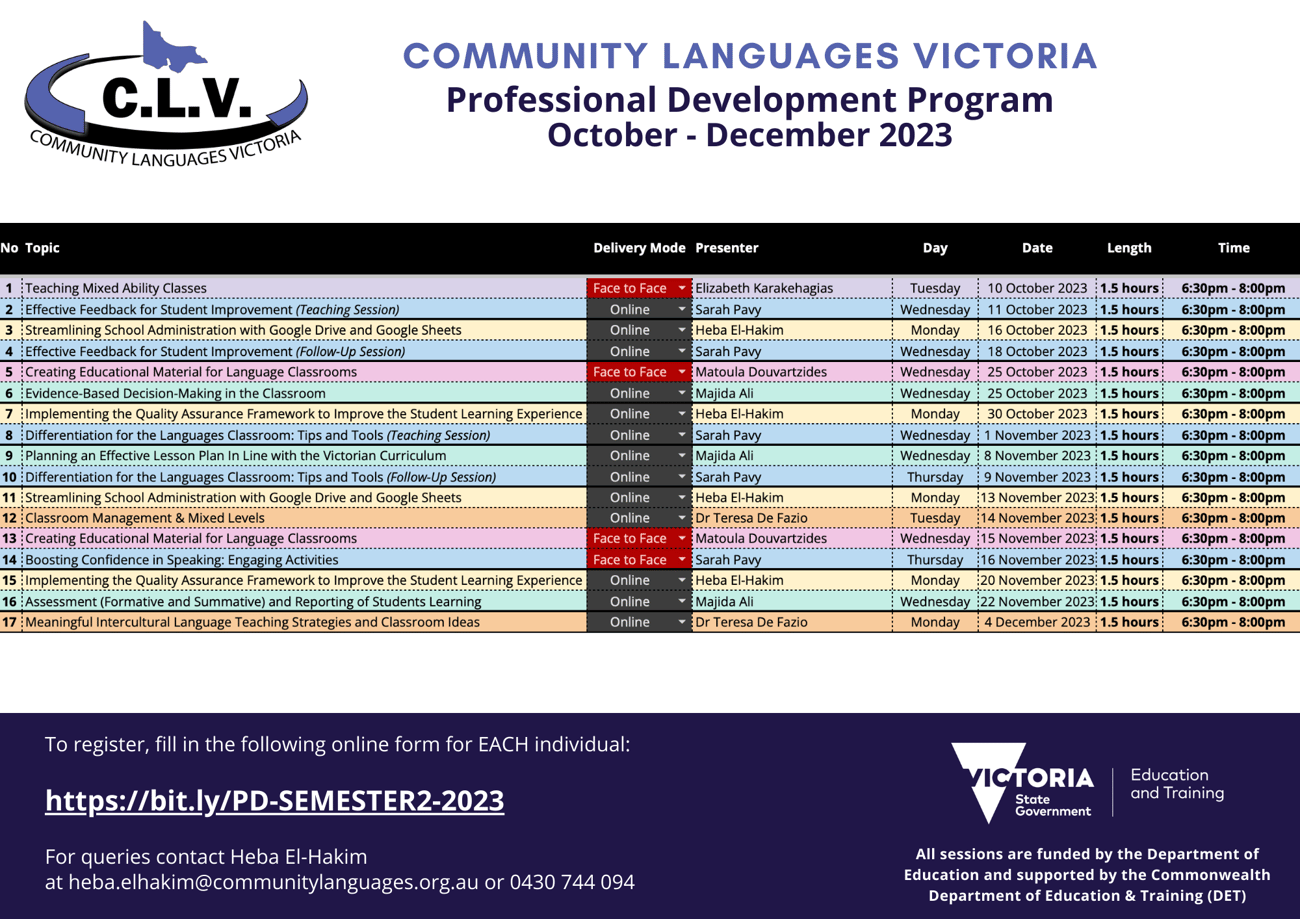
We are pleased to announce that the Professional Development Program for Semester 2, 2023 is now READY!
We've brought back some in-demand relevant topics and presenters for you. We're also continuing with a mix of face-to-face and online sessions. The face-to-face sessions require a good number of registrations to go ahead.
Click HERE to download the Semester 2 PD Program
Register HERE: https://bit.ly/PD-SEMESTER2-2023
Please submit ONE form per participant.
LEARNING OUTCOMES
Teaching Mixed Ability Classes
Elizabeth Karakehagias
Every classroom has many layers of attainment and achievement. This brings challenges that can be addressed through careful planning.
Participants will be able to:
- Participate collaboratively in shared class experiences
- Develop the ability and confidence to respond to questions and use key features of the language
Effective Feedback for Student Improvement
Sarah Pavy
Teaching Session:
The ways in which we think about feedback and embed this into our teaching and learning cycle have a powerful impact on student learning. This webinar will examine effective feedback, how to engage students in the feedback process, and ways to optimize learning. This webinar will encourage teachers to reflect on their current feedback practices, consider a range of methods for giving feedback, and plan for active student involvement in feedback and improvement.
Follow-Up Session:
This is a follow-up session to the teaching session where Sarah will check in with you on what you've been able to implement from what you learned. It will be a helpful session to get any questions answered that might have come up since the teaching session.
Streamlining School Administration with Google Drive and Google Sheets
Heba El-Hakim
Participants will discover:
- How to work with Google Drive to streamline all their school administrative tasks
- An effective template to keep track of enrolments and have a solid onboarding process
- Four ways or reasons to use Google Drive to both streamline administrative tasks and model effective use of technology.
Creating Educational Materials for Language Classrooms
Matoula Douvartzides
This session will help teachers understand how to create teaching and learning materials to facilitate students’ level of learning and how to make lessons interesting and easy to understand.
Evidence-Based Decision-Making in the Classroom
Majida Ali
Teachers will learn how evidence-based decisions can help:
- Improve student outcomes
- Enhance teaching practices
- Personalise instruction
- Increase professional credibility
- Collaboration and professional growth
- Accountability and transparency
- Make informed choices that have a positive impact on student learning outcomes
Implementing the Quality Assurance Framework to Improve the Student Learning Experience
Heba El-Hakim
Explore the practical implementation of the Quality Assurance Framework (QAF) for your school. The eight Dimensions of the QAF combine to provide an overview of best practices in teaching and learning and school operation and management. By embracing the QAF approach, community language schools can revolutionise their teaching methodologies, improve student outcomes, and ensure high quality across all operational aspects. Gain invaluable knowledge, tools, and practical guidance that will empower teachers, principals, and administrators to offer an exceptional language learning experience.
Differentiation for the Languages Classroom: Tips and Tools
Sarah Pavy
Teaching Session:
Professional learning on differentiation can often make it sound hard, time-consuming, and difficult to transfer to the language classroom. However, differentiation can be fun for both students and teachers with the right tools. This session will focus on simple, practical, low-preparation approaches to effective differentiation in the language classroom. Participants will be provided with examples of simple activities and strategies that can be applied across a variety of topic areas and grammatical concepts and adjusted to suit both primary and secondary settings. Teachers will return to classrooms with ideas that can be implemented immediately to engage students of a range of abilities and needs.
Follow-Up Session:
This is a follow-up session to the teaching session where Sarah will check in with you on what you've been able to implement from what you learned. It will be a helpful session to get any questions answered that might have come up since the teaching session.
Planning an Effective Lesson Plan In Line with the Victorian Curriculum
Majida Ali
Teachers will learn:
- The 4-step process to designing an effective lesson plan.
- About learning intentions and success criteria.
- How to link their topic to the Victorian Curriculum description and achievement standards.
Classroom Management & Mixed Levels
Dr Teresa De Fazio, OAM
Teachers will learn to:
- Identify and examine challenges that arise in mixed-level language classes
- Develop practical activities to support working in challenging mixed-level classroom settings
- Analyse approaches to classroom management in relation to accommodating and harnessing mixed-levels
Boosting Confidence in Speaking: Engaging Activities
Sarah Pavy
This session gets teachers actively participating in a range of oral language activities and games that encourage the use of target language to develop skills for real-life conversation, engage students, and get the buzz into our Language classrooms. Teachers will get a feel of how these activities work in the classroom by taking part and will also have the opportunity to share ideas of how they can be transferred across different year levels and topics.
Assessment (Formative and Summative) and Reporting of Students Learning
Majida Ali
Teachers will learn:
- The difference between formative and summative assessment.
- The importance of formative assessment to inform planning.
- How to use summative assessment to report on student learning.
Meaningful Intercultural Language Teaching Strategies and Classroom Ideas
Dr Teresa De Fazio, OAM
Teachers will learn to:
- Explore the notion of intercultural language teaching in the community language setting.
- Examine practical ideas to support using intercultural language teaching methods to engage students.
- Unpack ways of assessing intercultural language teaching in the classroom.
|
|
|
|
|
If you have any questions or need assistance with anything, or even wish to suggest some Professional Development Topics you would like to have us organise, please send me an email; I love hearing from you!
Kind Regards,
Heba El-Hakim | Project Coordinator
Community Languages Victoria / Community Languages Australia
Mobile: 0430 744 094
Email: heba.elhakim@communitylanguages.org.au
Website: CLV / CLA
I acknowledge the Traditional Owners of the land on which I work, and pay my respects to the Elders, past, present and emerging.
|
|
|
|
|
|
|